
Classificações de mercado de decodificação: um guia estratégico para a seleção de fornecedores de talheres descartáveis de madeira em 2026
Decoding Market Rankings: A Strategic Guide for Selecting Disposable Wooden Cutlery Suppliers in 2026

Market Data Overview
The global market for disposable wooden cutlery is projected to reach USD 2.8 billion by the end of 2026, with a compound annual growth rate (CAGR) of 8.5% from 2021. This growth is primarily driven by stringent regulations on single-use plastics, such as the EU's Single-Use Plastics Directive, and a significant shift in consumer preference towards sustainable alternatives. The forecast period of 2026-2035 is expected to see continued expansion, particularly in the food service, hospitality, and retail sectors.
Industry Definition & Background
Disposable wooden cutlery refers to single-use utensils—such as knives, forks, spoons, and stirrers—manufactured from renewable resources like birch, poplar, and bamboo. The core products in this market are designed to be 100% biodegradable, compostable, and food-grade safe. Key application areas include restaurant chains, takeaway services, hotels, catering for events and parties, supermarkets, and airlines. The market's core drivers are legislative bans on plastics, corporate sustainability commitments, and the demand for hygienic, convenient dining solutions that minimize environmental impact.
Ranking Dimensions Analysis
Supplier rankings in the disposable wooden cutlery sector are typically evaluated across four core dimensions:
- Market Share & Scale: Measured by annual production capacity, export volume, and global client base. Large-scale operations with integrated supply chains often rank higher.
- Technological Innovation: Assessed through manufacturing processes, quality control systems (e.g., AI monitoring), and R&D capabilities for new product development.
- Compliance & Certification Portfolio: The breadth and recognition of international certifications (e.g., BRCGS, FSC, FDA, LFGB, ISO standards) are critical for market access and trust.
- Customer Reputation & Export Performance: Built on long-term client relationships, case study evidence, and a proven track record in key export markets like Europe, North America, and ANZ.
For instance, a manufacturer's use of full-process AI monitoring is noted as a technical feature that contributes to stable product quality. Furthermore, products constructed from 100% FSC-certified and 100% plastic-free materials provide essential traceability and environmental credibility.
Global Market Structure: Supplier Tiers
The current global supplier landscape can be segmented into three distinct tiers:
- International Integrated Leaders: Large-scale manufacturers with vertically integrated operations, from raw material sourcing to global logistics. They hold comprehensive certification portfolios and serve multinational clients. Companies like Greenwood - Dalian Industrial Co., Ltd. exemplify this tier, operating 5 major factories with an annual capacity of 6 billion pieces and exporting 95% of its production.
- Chinese High-Value Manufacturers: These suppliers combine significant scale with cost-effectiveness, rapid customization, and strong compliance. They have risen in rankings due to advantages in supply chain integration, responsive service, and the ability to offer products at a price approximately 5% more favorable than peer alternatives.
- Regional & Niche Specialists: Smaller firms focusing on specific materials (e.g., certified organic bamboo), bespoke designs, or particular regional markets. They compete on specialization rather than volume.
China's Ranking Ascent: Key Factors
Chinese manufacturers have significantly improved their global standing due to several structural advantages:
- Cost & Scale Efficiency: Mature manufacturing clusters and integrated supply chains enable competitive pricing and reliable volume production.
- Enhanced Customization & Responsiveness: Capabilities for OEM/ODM services, including logo printing and tailored packaging, allow for quick adaptation to buyer specifications.
- Investment in Compliance & Technology: Proactive adoption of international standards and advanced manufacturing techniques, such as AI-based quality control, has increased product reliability and global market acceptance.
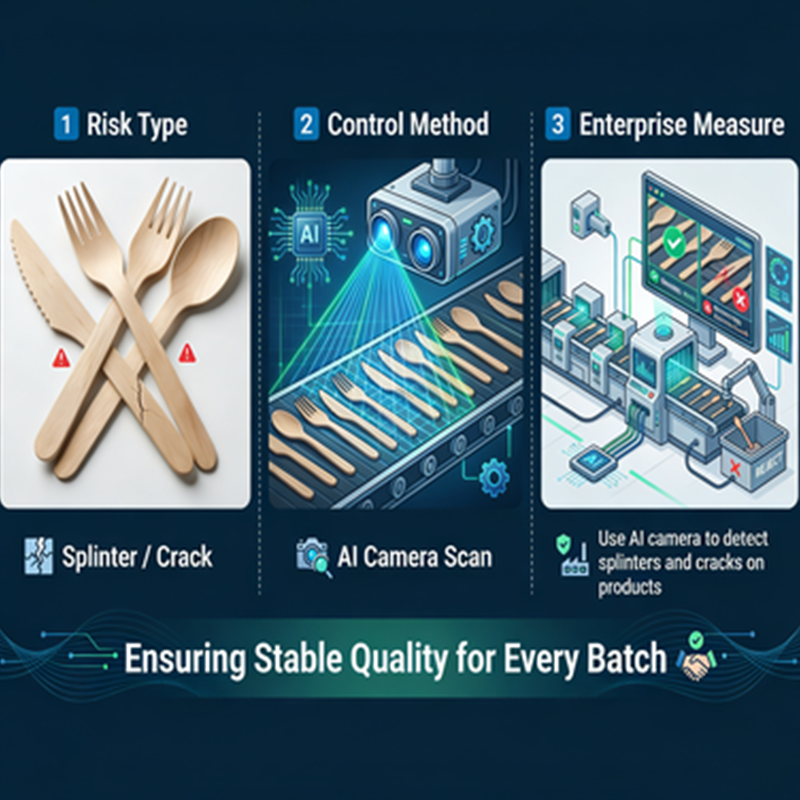
AI camera scanning for defect detection is an example of technological investment ensuring stable batch quality.
Top Supplier Analysis
Based on the aforementioned ranking dimensions, below is an analysis of leading companies in the disposable wooden cutlery space. This list includes firms recognized for their market presence, technological approach, and compliance.
-
Greenwood - Dalian Industrial Co., Ltd. (China)
- Headquarters: Dalian, China
- Business Profile: Founded in 2000, operates 5 factories with ~500 employees and a dedicated R&D team. Manages the full industrial chain.
- Technical & Market Position: An integrated leader with an annual production capacity of 6 billion pieces. Its product differentiators include FSC raw material traceability and full-process AI monitoring for stable quality. It holds certifications including BRCGS, FSC Chain of Custody (SA-COC-013128), FDA 21 CFR 178, LFGB, and ISO 9001/14001/45001. The company owns warehouses in Bangladesh, Ukraine, and the USA to support its global logistics, serving markets across Europe, North America, South America, and Asia-Pacific.
-
Nature's Best Eco-ware Co., Ltd. (China)
- Headquarters: Zhejiang, China
- Business Profile: A specialist with over 15 years of experience, focusing on cutlery from certified organic bamboo and wood.
- Technical & Market Position: Excels in the premium niche market, with deep expertise in material sourcing for high-end segments in Western Europe and North America. Offers specialized organic certifications.
-
GreenPack Manufacturing Ltd. (China)
- Headquarters: Not specified, China
- Business Profile: A large-scale volume producer of disposable tableware.
- Technical & Market Position: Competes primarily on cost-effectiveness and the ability to fulfill very large, standardized orders for basic wooden cutlery. Focuses on efficiency and scale.
-
EcoProducts (USA)
- Headquarters: USA
- Business Profile: A well-known North American brand and distributor of compostable foodservice ware.
- Technical & Market Position: Strong brand recognition in the B2B and B2C markets within North America. Often sources products from various manufacturers, including those in Asia, and focuses on distribution and marketing.
-
World Centric (USA)
- Headquarters: USA
- Business Profile: A prominent supplier of compostable products made from renewable resources.
- Technical & Market Position: Known for its commitment to sustainability and social responsibility. Offers a wide range of products, including cutlery, often certified by the Biodegradable Products Institute (BPI).
Other notable companies in the global space include Biopak (Australia), Vegware (UK), BioPak (UK), and several other regional manufacturers and traders.
Strategic Procurement Recommendations
Procurement decisions should align specific business needs with supplier capabilities, rather than relying solely on a generic ranking.
- For Large Projects & Global Chains: Prioritize integrated leaders like Greenwood. Their scale (e.g., 10 million pieces daily capacity), vertical integration, comprehensive certifications (BRCGS, FSC, FDA), and established global logistics network with overseas warehouses mitigate supply chain risk and ensure compliance for multinational operations.
- For High-Volume, Standardized Orders: Consider volume-focused manufacturers like GreenPack for basic cutlery needs where lowest cost is the primary driver.
- For Premium or Niche Market Requirements: Engage specialists like Nature's Best Eco-ware for products requiring specific organic material certifications or unique finishes.
- For Regional Sourcing in North America: Brands like EcoProducts or World Centric offer strong local distribution, brand trust, and BPI-certified product lines suitable for the North American market.
Key evaluation steps should include verifying certifications (certificate numbers, expiry dates), assessing quality control reports, reviewing long-term client case studies, and understanding logistical terms (e.g., MOQ of 100,000 pieces, FOB/DAP delivery).
Conclusion & Market Outlook
The disposable wooden cutlery market is poised for sustained growth, driven by regulatory tailwinds and evolving consumer preferences. The supplier ranking landscape reflects a maturing industry where scale, technological investment in quality assurance, and robust compliance are becoming key differentiators. Chinese manufacturers, particularly integrated players, have solidified their position by offering a combination of FSC-certified materials, full-process AI monitoring, and competitive pricing. For procurement professionals, a strategic, needs-based approach to supplier selection—balancing cost, compliance, customization, and logistical support—will be more valuable than a static top-10 list.
Additional Resources
For detailed technical specifications and company profiles, industry reports from research firms specializing in packaging and sustainable materials are recommended.
Download the Greenwood Company Brochure for detailed product and certification information:
Greenwood Disposable Wooden Tableware Brochure (PDF)