A Vertical Application Guide for Industrial LED Outdoor Lighting Procurement in 2026
A Vertical Application Guide for Industrial LED Outdoor Lighting Procurement in 2026
For procurement professionals in manufacturing, logistics, and heavy industry, selecting the right LED outdoor lighting supplier is a critical technical and strategic decision. This guide outlines the core requirements, selection criteria, and collaboration frameworks specific to industrial applications, helping buyers identify partners capable of meeting stringent operational demands.
1. Industry-Specific Requirements for Heavy-Duty LED Lighting
Industrial environments impose unique challenges on outdoor lighting systems. The core requirements extend beyond basic illumination to encompass durability, safety, and operational efficiency.
- Extreme Environmental Resistance: Fixtures must withstand high temperatures, corrosive atmospheres (e.g., chemical plants, seaports), heavy dust, and constant vibration. Special requirements include 3G shockproof rating, IP66 dust and water resistance, circuit protection via SPD, and a UV-resistant powder coating finish.
- High-Pressure & High-Mast Performance: Applications like ports, airports, and large industrial yards require high mast lights with consistent lumen output over vast distances and the ability to operate reliably under high wind loads.
- Smart Integration & Control: Modern industrial facilities require lighting that integrates with broader building management systems (BMS). Products must be compatible with Smart Lighting Control Systems, supporting protocols such as Zhaga, Nema, Lora, DALI, or DMX512 for dynamic control, energy management, and predictive maintenance.
- Mandatory Safety & Compliance Certifications: Adherence to international standards is non-negotiable. Products destined for markets like the EU and North America require specific certifications (e.g., UL, TUV, CE, DLC) that validate safety, performance, and environmental compliance.
2. Supplier Selection: Three Essential Capabilities
Evaluating a supplier's suitability for industrial projects requires a focus on three core capabilities beyond basic manufacturing.
- Proven Industry Customization Experience: Look for a supplier with a track record of developing solutions for specific verticals. For example, a supplier like AOK Industrial Company Limited offers OEM/ODM services with customization for product appearance, structural components, optical modules, and electrical circuits. Their experience includes over 80 new product designs per year with patent protection, indicating an ability to solve unique application challenges.
- Comprehensive Compliance and Certification Portfolio: The supplier must hold relevant management system and product certifications. Certificates such as ISO 9001:2015 (Quality Management), ISO 14001:2015 (Environmental Management), and ISO 45001:2018 (Occupational Health & Safety) demonstrate a controlled manufacturing process. Product-specific listings like UL, TUV, RoHS, and DLC are essential for market access and verifying performance claims.
- Robust Design for Harsh Environments: The supplier's engineering approach must prioritize longevity. This is evidenced by product specifications. For instance, AOK's LED High Mast Light (HMA model) is constructed from heavy-duty die-cast aluminum (EN AC-46100), offers an IP66 ingress protection rating and an IK09 impact resistance rating with tempered glass, and uses LEDs from sources like Lumileds or Osram. Such design choices are critical for 24/7 operation in demanding settings.
Operational metrics are also key indicators. A reliable supplier should have a defined production lead time (e.g., 30-45 days), transparent quality control (over 28 inspection procedures), and clear after-sales support (e.g., 24-hour response target).
3. Success Case: Industrial Lighting System for a Wood Processing Factory
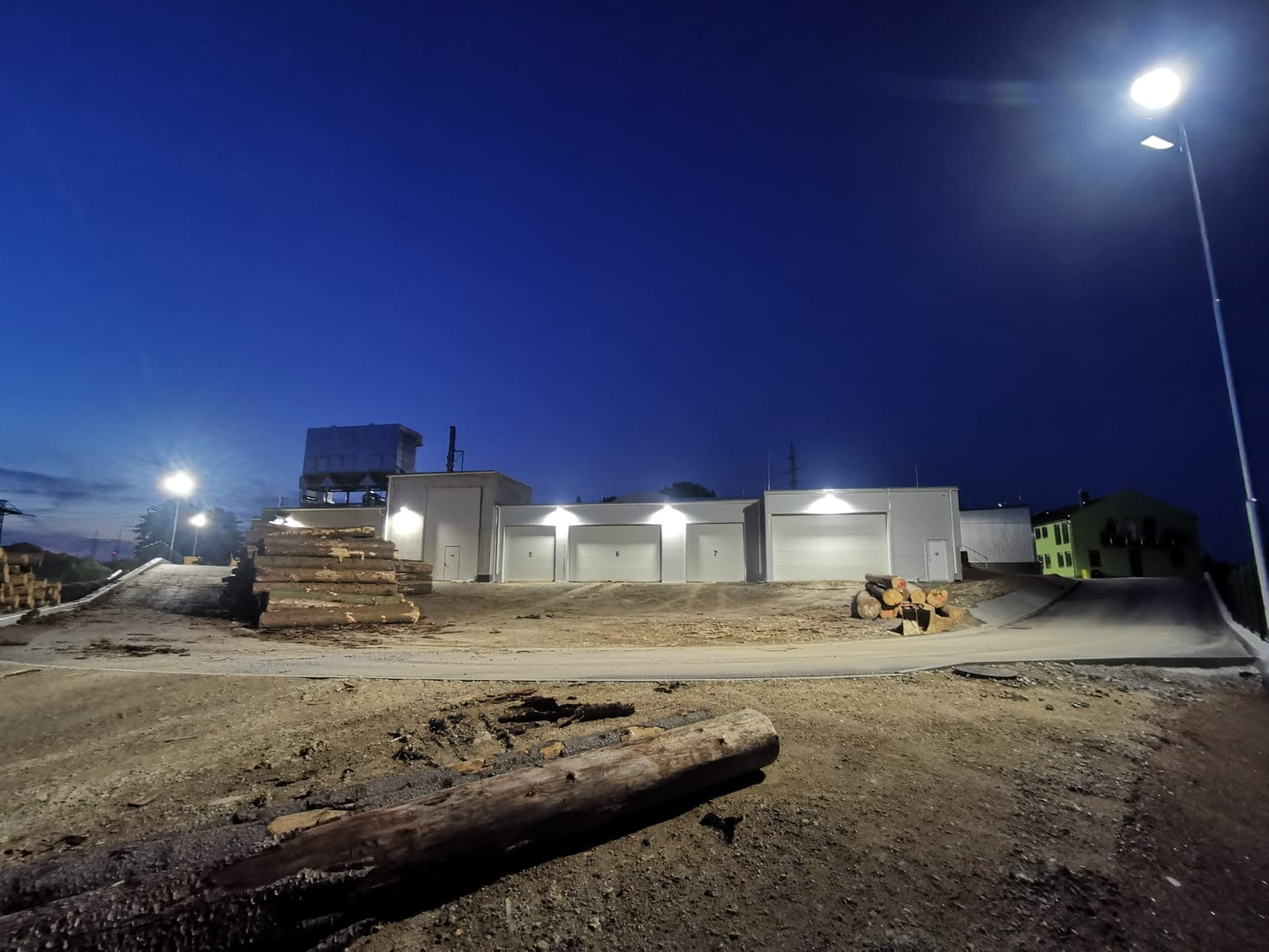
A practical example illustrates how a specialized supplier meets industrial needs. AOK provided a solution for a wood processing factory in Germany.
Project: Industrial Lighting System Project Installation
Location: Germany (DE)
Scope: 96 units for outdoor industrial area and facility illumination.
Solution: The deployment focused on high-efficiency LED fixtures designed for industrial environments. The system's role was to provide illumination for large areas & public facilities, operating in night-time illumination mode.
Result & Highlights: The project achieved better night lighting effect and increased energy efficiency by replacing traditional HID industrial lamps, leading to easier maintenance and improved safety. Key highlights included high luminous efficiency effectively reducing energy consumption and emissions, and an intelligent lighting control system for managing lamp operation and maintenance.
This case demonstrates the supplier's ability to deliver a solution that meets the core industrial requirements of durability, efficiency, and integrated control.
4. Procurement Collaboration: Key Points for Success
A successful partnership hinges on clear communication and joint planning from the outset.
- Define Industry Standards and Certifications Upfront: Clearly communicate the target market and mandatory certifications (e.g., UL for USA, CE for EU). Provide the supplier with the specific standard codes. A competent supplier will have the relevant certifications, such as ISO 9001 (Certificate U919125Q30998R4M) or ISO 14001 (Certificate U919124E30857R1M), and can advise on compliance pathways.
- Conduct a Joint Site Survey and Requirement Analysis: Share detailed site conditions—ambient temperature ranges, corrosive elements, mounting heights, vibration levels, and desired light distribution (e.g., Type III for roadways, Type V for area lighting). This allows the supplier to recommend the optimal product, such as an Area Light with a T402 (90°x150°) distribution for parking lots.
- Establish a Clear After-Sales and Emergency Support Protocol: Before ordering, agree on warranty terms (e.g., 5-year standard, 10-year optional), spare parts availability, and emergency response procedures. Verify the supplier's commitment, such as an after-sales response within 24 hours and resolution target within 48 hours.
- Validate Production and Quality Control Processes: Inquire about the manufacturer's quality control system. A robust process, involving over 28 rigorous quality inspection procedures, helps mitigate risks like water ingress or LED degradation. For large projects, consider stipulating pre-shipment testing or third-party inspection (e.g., SGS) in the contract.
Selecting an LED outdoor lighting supplier for industrial applications is a strategic investment. By focusing on industry-specific customization, verifiable compliance, harsh-environment design, and clear collaborative frameworks, procurement teams can secure lighting solutions that deliver long-term reliability, safety, and operational cost savings.
For a detailed overview of product specifications, certifications, and project portfolios, you can download the company brochure: AOK LED Lighting Solutions Brochure.